Electronic Projects and Restorations |
70's/80's
Dynaco Stereo
I've restored a set of 70's-80's stereo equipment. I bought the Sony TC-8 new (lower right) and a Sony TC-366 in 1970 which I later upgraded to this TC-377.
| Equipment | Date | Original Price |
| Sony TC-8 Eight Track Recorder | 1969 | $129.50 |
| Sony TC-377 Reel-Reel | 1972-77 | $420.00 |
| Dual 1242 Turntable / Shure V15 TypeII | 1978 | $225.00 |
| Dynaco PAT-4 Preamplifier | 1967 | $89.95 kit / $129.95 assembled |
| Dynaco FM-5 FM Tuner | 1971 | $199.00 kit / $319.00 assembled |
| Dynaco ST-120 Stereo Amplifier | 1966 | $159.95 kit / $199.95 assembled |
| Numark TC4100 Tape Mixer | 1985 |
$99.00 |
| JBL L60T Speakers | 1985 |
$265.00 each |
|
Total $1852.40 (in kit form) |

Dynaco FM-5 Tuner Replacement Lamps
The Dynaco FM-5 tuner that had one lamp burned out. All of the replacement information I found on the web indicated that replacement lamps are not available. Well, I found some! They are 12 volt fluorette lamps and I have found them at several doll house suppliers. My one good original lamp measured 140 mA and these replacements are 80 mA but appear just as bright. I bought the clear CK1018-1 clear lamps and my ends caps were straight instead of the conical end caps as shown in the photo. The overall bulb is the same size and fits perfectly.

Dual 1242 Turntable Adjustments
It took me a while to figure out how to adjust the turntable set-down for 7" and 12" records. The adjustment is under the Dual label on the right front. The logo snaps out of an adjustment hole and rotates clockwise. There is an index pin in the upper right side of the logo. There are two adjustment screws, one for each speed / size. The 'trick' is the opposite adjustment screw is in position. When the speed is 33 rpm, the 45 rpm adjustment screw is in position. You need to change the speed to 45 rpm, adjust the screw, change the speed back to 33 rpm, and try the set-down. The opposite procedure is used to adjust the screw for 45 rpm.
It also took me a while to figure out how to remove the turntable from the base. First, remove both screws holding the cable plate from the bottom. Then loosen each of the three mounting lockdown screws. With these screws loose, you can lift the turntable and angle the screw so the disc on the end clears the mounting slot. You have to do each of the screws separately.
The anti-skating control has three scales on it. The top upper scale has a horizontal ellipse indicating adjustment for an elliptical stylus. Below that is a scale with a small circle indicating the adjustment for a conical stylus. On the bottom is a scale labeled CD4 indicating adjustment for the special four channel stylus.
70's/80's
Marantz Stereo
I've also restored this set of 70's-80's quad stereo equipment.
| Equipment | Date | Original Price |
| Sony TC-366-4 Quadradial Tape Deck | 1971 | $479.95 |
| Marantz 6150 Turntable / ADC QLM36 MkIII | 1977-79 | $180.00 |
| Marantz 4230 Quad Receiver | 1973-78 | $550.00 |
| Advent speakers | 1971 | $116.00 each |
| Total $1441.95 |

Marantz 6150 Turntable Repair
The Marantz 6150 turntable uses a direct-drive servo motor which pulsed at 33-1/3 RPM and was too fast at 45 RPM. I removed the rear cover of the servo motor exposing the control PCB. There are ~10 square pins you need to unsolder to remove the control PCB. There are two tantalum capacitors and five electrolytic capacitors plus a handful of other parts on the control PCB. I replaced all capacitors although I probably just had to replace the tantalum capacitors as I think they are the timing capacitors for the controller IC. The tantalum capacitor values are 0.68 µF and 1.0 µF. The electrolytic capacitor values are 4.7 µF (qty 3), 47 µF and 100 µF. Capacitor polarity is silk screened on the PCB making the repairs easy. Sorry, no pictures.
Electronic Projects |
I bought the Niigata NS73M FM transmitter module from Sparkfun. I prototyped it with my AVR Butterfly module using the Nuts & Volts May 2008 article. I reduced the code size by taking out the audio generator so it would compile with the Bascom-AVR demo software.
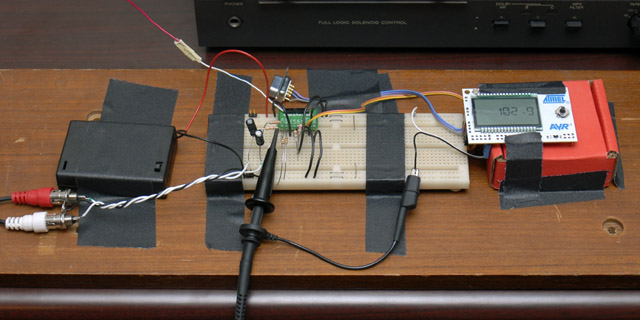
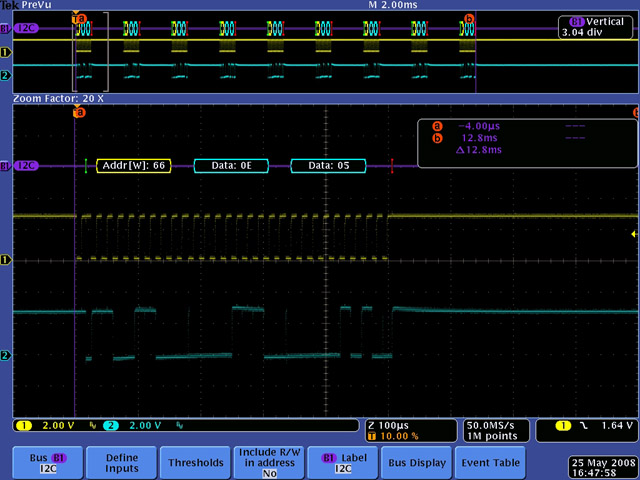
I wrote a Basic program for an ATTINY13 to initialize the NS73M at a fixed frequency of 102.9 MHz. The Bascom-AVR compiler I2C support made the program quite easy. 9 bytes of data is all that is required to program the NS73M.
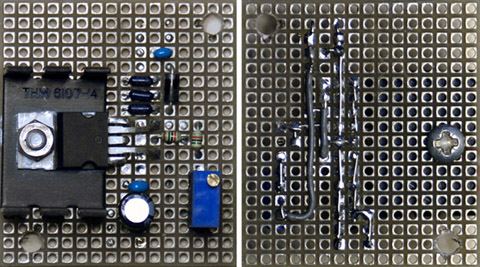
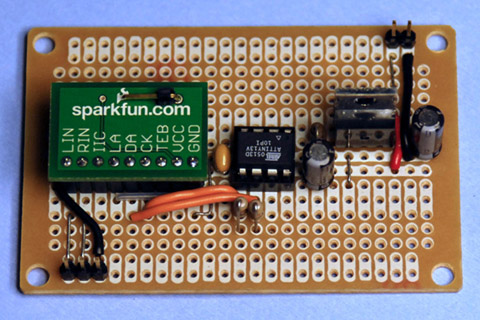
The finished FM transmitter is very simple consisting of a 3V regulator, ATTINY13, NS73M, and a handful of passive components. I get good coverage through the entire house with a 32" antenna.
DJB-FM transmitter Basic source code
Scrolling Car Display
This project is a follow-on from PSIM display work. Since this VFD easily interfaces with 9600 baud serial I decided to build a scrolling message board. I chose the ATTINY13 processor because of it's small size. I ported the Atmel AVR304 application note implementing a software uart to the ATTINY13 processor and used an additional pin to blank the display.
Vacuum fluorescent display software source code
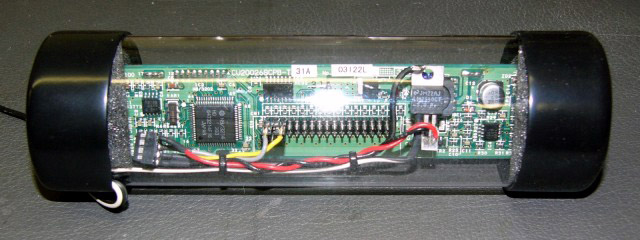
I set the display to 50% brightness which limits the total power consumption to ~280 mA. I used a LM2940 low dropout regulator to be able to power this from a 6 volt battery in my 1949 Chevy. I assembled the display in a 1.5" clear plastic tube. The ATTINY13 is the small DIP on the left at the end of the wires and the LM2940 regulator is on the right mounted to the 2 pin power connector.
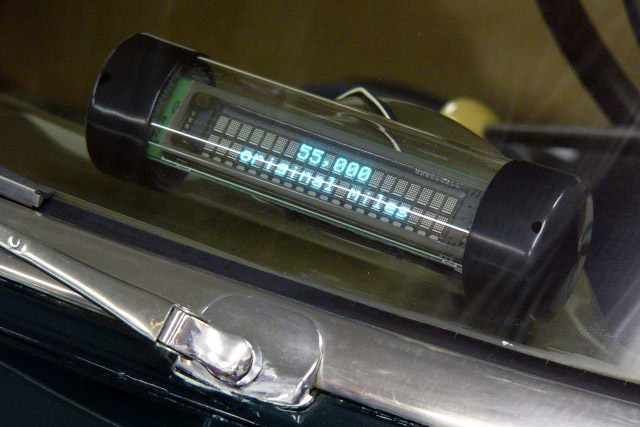
Here is the display on the dashboard of my 1949 Chevy. It slowly scrolls information on the car including the name, year, model number, mileage, original content, and owner.
Electronic Repairs and Restorations |
The NiCd battery in the DPM C8 is know to leak and damage the motherboard. My DPM C8 was still functional but I decided to pull the bottom panel and examine the battery. It had corroded and there was damage to the PCB Some of the leakage had dripped to the metal cover and started corrosion there as well.

I removed the battery and tried to clean up the traces. The copper had corroded quite badly and I didn't want to just leave it for fear that it would continue to corrode. I used a small wire brush and a Dremel tool to clean the traces down to copper. I tinned the exposed copper and the large areas were fine but the small traces were too damaged. I jumpered each of the five traces with wire and also the battery power traces since the vias were most likely damaged.

I replaced the battery with a Dantona COMP-16-3P nickel metal hydride. It was the same form factor for mounting on the PCB but I moved it to the rear of the serial port cover.
The unit powered up and the display was mostly correct except the preset names were all smiley faces. Holding '0' and 'Enter' keys depressed while powering on initialized the non-volatile memory correctly.

Peavey will supply the schematics on discontinued products if requested. The set I received only covers the motherboard and one of the front panel switch boards. I've created a drawing of the cable connections to the motherboard.
Alesis Quadraverb-Plus Repair New
My Alesis Quadraverb stopped working and was displaying garbage characters on the LCD. I assumed it was an intermittent connection and reseated all the ICs and cables with no affect. I found that reinitializing memory corrected the problem. The 3.6 volt lithium battery was dead and I'm guessing the Quadraverb requires battery-backed memory to be valid for correct operation. Replacing the battery and performing a hard reset corrected the problem.
Here are the various functions that can be accessed by key combinations:
| Key Combinations | Operation |
| Software version | Press both Page buttons (mine is version 2.02) |
| Hard reset / memory initialization | Hold the Prog and Bypass buttons while powering on |
| Internal diagnostics | Hold the Config, Pitch and Bypass buttons while powering on. Note - need to connect midi cable from In to Out for MIDI test. Remove cable when complete. |
Sunken Speaker Repair New
I had four Sunn 10 inch speakers that were very inefficient. I believe these speakers date from the mid 70's and have paper surrounds. Upon inspection I found that the cones have sunk inwards. In their normal at-rest position they are almost at the bottom of their travel range so they have very little compliance inwards (and hence very little volume). I've seen postings on the web for speakers that had sunk in and one site described a repair by moistening the surrounds and holding the cone outward until dry. I tried it and it worked! I experimented with different methods of holding the cone outwards. I tried foam between the frame and cone but this tended to deform the cone. I settled on using two small wood levers with an angled end to fit flush against the cone where the spider connects. I pried the levers against the frame to hold the cone outwards until the surround was parallel to the front of the speaker. I sprayed water on the paper surrounds and used a small brush to spread it to thoroughly soak the paper. When the surrounds dried the cone remained in this position. I have no idea why the speakers developed this condition nor how long this repair might last.
Magnatone MP-3 Guitar Amplifier Repair New
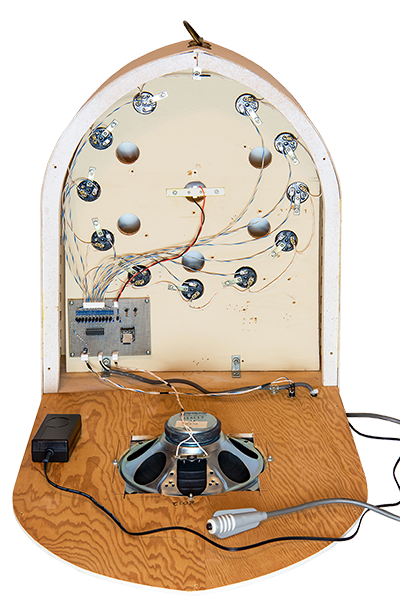
I bought a basket-case Magnatone MP-3 guitar amplifier to restore. All that remained was a partial chassis and a cabinet. There were no tubes, speakers, reverb tank and some of the components had been cut from the chassis. I recovered the cabinet, replaced the grill cloth, repaired the amplifier, and replaced the reverb tank and Jensen speakers some years ago. One of the neat features of this 1966 amplifier was the front panel was rear-lit by electroluminescent panels with a dimmer control! The panels and dimmer control were gone so I had no idea what they looked like or how they were installed. I kept searching surplus sites and years later found some electroluminescent panels that were about the right length. Each panel was made up of three sections so I bought three (two to use and one for a spare). The panel was the perfect length for the right side but too short for the left side. I cut my extra panel off after the first section and used this to extend the left side. These panels are powered from the secondary high voltage side of the transformer through a series limiting resistor and rheostat to control the brightness. The legends looks pretty slick! This picture was taken with normal overhead lighting and the dimmer control on the lowest setting.


Marantz 2240 Legend Restoration New
I have a Marantz 2240 receiver which the power legend had worn off. I made a new legend using decal paper and Schneidler Mediaeval Black fonts. I scaled the fonts to 70% height to compress them and added a bit of horizontal spacing between the letters. I tried a reverse image and gluing the transfer directly to the front but I never could find a glue that I could wipe away the excess without destroying the legend edges. Instead I made a regular decal with 3 coats of lacquer as a binder and used a soft tip brush with lacquer thinner to blend the edges of the binder. The legend is a bit lower in contrast with a bit too much horizontal spacing. Now that I know how these decals work I could improve the legend but I think it looks good enough.

Here is a 3" decal I made and put on a piece of finished birch.

Rhodes 100W Suitcase Repair New
I have several Rhodes 73 key suitcase pianos but the newest one has the 100W amplifier and needed the power switch replaced. The neon light no longer worked and I could hear popping and hissing when turned on so I knew it was internally arcing. I believe the original switch was a Carling LTGMO500-TB-B-R/125N and none of the Carling distributors had this in stock. Most all of the other brands of illuminated rocker switches are made for a different size panel cutout. The Philmore 30-16867 red illuminated rocker switch does fits the 1.0 x 1.125 inch panel cutout. The switch has 0.25 inch spade connectors instead of solder lugs and the light is wired to the two center contacts. The Carling switch has the light connected to two isolated contacts so the circuit requires some wiring modifications.
|
120V AC Switch Modification Notes: Caution - this modification deals with primary high voltage wiring. On no account should this modification be attempted if you are not familiar with safe connection of high voltage primary wiring and insulation. Warning - this modification is for 120V AC primary only. 240V AC requires a different modification.
|